
'Normal' is not coming back
Ten things three universities taught me about the populist revolt - and why the centre cannot simply wait it out.

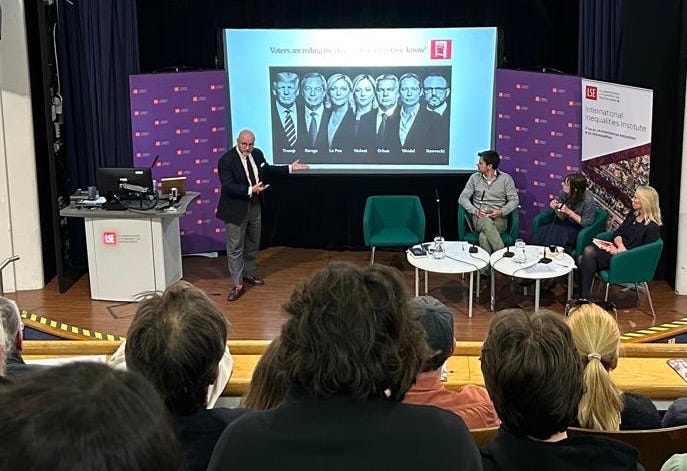
Westminster has been in turmoil.
And so dodging calls from candidates and an insatiable media, I’ve been somewhere else debating one question - the question that matters most right now: why are populists winning, and how do we beat them?
Along with hundreds of conversations on the streets of my constituency, I’ve been at the LSE, King’s College London and the University of Bath, sharing a stage with Bobby Duffy, Gaby Hinsliff, Sam Freedman, Roberto Foa, Andy Summers, Zoe Williams, Sara Hobolt and David Klemperer talking about my new book. We debated with students, researchers, journalists, campaigners, and the public who asked difficult questions.
The discussions were sobering. Sometimes uncomfortable. Occasionally hopeful.
What struck me most was not that we disagreed about everything. It was that we increasingly agreed on something more unsettling: the old assumptions about politics no longer hold.
So here are ten things I learned - or, more honestly, ten questions I’m still wrestling with.
1/. We may not be closer to 1933 than we think
Perhaps the bluntest conclusion running through all our conversations was this: the forces driving populism are not weakening. They are intensifying.
Stagnant living standards. Deepening wealth inequality. Migration pressures. Social fragmentation. Digital radicalisation. Geopolitical insecurity. The rise of AI. And governments across the West with very little fiscal room to respond to the next shock.
At King’s, Bobby Duffy put it carefully - but it was chilling:
“Something has definitely moved.”
For years, Bobby and his team had argued Britain was not as polarised as America. That the country still retained higher levels of trust and overlap between political tribes than many commentators admitted.
But the data now points somewhere darker.
More people believe Britain is changing too fast. More people think culture wars are becoming a serious problem. More people feel nostalgia for a country they believe has disappeared.
The danger is not simply today’s populists. The danger is what happens if another major economic shock hits societies already this fragile.
The centre cannot simply wait this out. Normal is not coming back.
2/. Britain is not America. But we are drifting towards US-style identity politics.
Bobby Duffy’s intervention at King’s was one of the most important warnings I heard anywhere. He has long argued that culture wars are often misunderstood. As he put it:
“Culture wars are not about individual cultural debates or particular issues. In the end, they’re about identity.”
That insight matters because once politics becomes tribal, people stop asking whether opponents are right or wrong. They start asking whether opponents are legitimate at all.
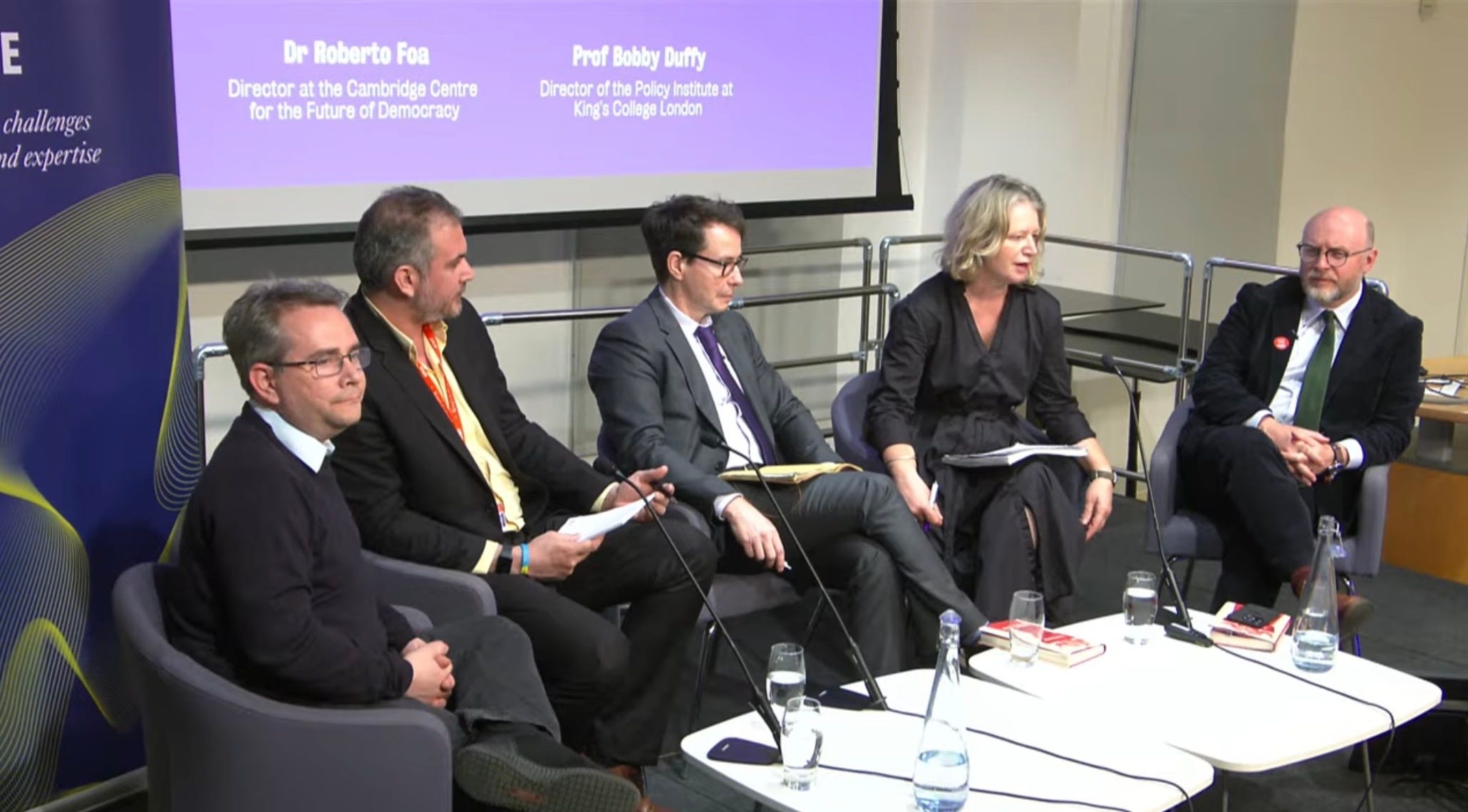
Bobby shared a useful framework of trust to help us think about this: the “ABI” model: ability, integrity and benevolence.
Can you deliver? Do you have principles? And finally:
“Are you on my side or not?”
That last question becomes very challenging in a more polarised society. When politics becomes purely identity-driven, benevolence collapses first. People cease believing the other side even wishes them well. That is how trust dies.
3/. Democracy’s promise has broken.
As readers of this column will known, my own view is that underlying this collapse of trust is simple: democracy’s bargain is no longer intact.
Work hard. Play by the rules. Get on. For millions of people, that no longer feels true.
Andy Summers’ work (along with Arun Advani) on wealth inequality helped frame much of the LSE conversation because it confronts an uncomfortable reality: since the financial crash, asset wealth has surged while wage growth has stagnated.
The result is not simply inequality of wealth. It is inequality of progress. Gaby Hinsliff captured this perfectly at King’s when she described the political mood as:
“People feeling they’re treading water, wading through treacle.”
And crucially, she added:
“It’s not just that you’re doing badly. It’s the sense that someone undeserving is doing well.”
That line matters because it explains why politics becomes so emotionally charged. Resentment grows fastest not simply from hardship, but from perceived unfairness.
If people believe effort no longer leads to reward, democracy itself begins to lose credibility.
4/. The inequality of progress of progress and desert is at the heart of the challenge
But simply looking at objective numbers on income, wealth and inequality does not explain the full extent of the challenge mainstream politics has to solve.
One of the most important interventions of the fortnight came from Professor Sara Hobolt. She challenged us to think harder about what is really driving the populist revolt. Is it simply material hardship? Or is it something more subjective - and therefore more politically combustible?
As she put it:
“How much of that is a real, lived experience… and how much of that is a subjective perception that things are really bad and they’re worse and they’re bad for me, and I deserve better?”
That phrase - “I deserve better” - stayed with me afterwards.
Because populism is not simply a revolt of the poorest. Many Reform voters are not the bottom of society. In fact, Sara pointed out something my data confirms. Reform voters have a median income and median wealth.
That matters enormously. Because it suggests the populist revolt is not driven only by economics. It is driven by disappointed expectations. By comparative decline. By status anxiety. By the feeling that the social contract has broken.
Millions of people believe they did everything society asked of them. They worked hard. Paid taxes. Raised families. Played by the rules. Yet when they look around, they feel others surged ahead while they stood still.
That is the emotional core of what I called during the discussion the inequality of progress.
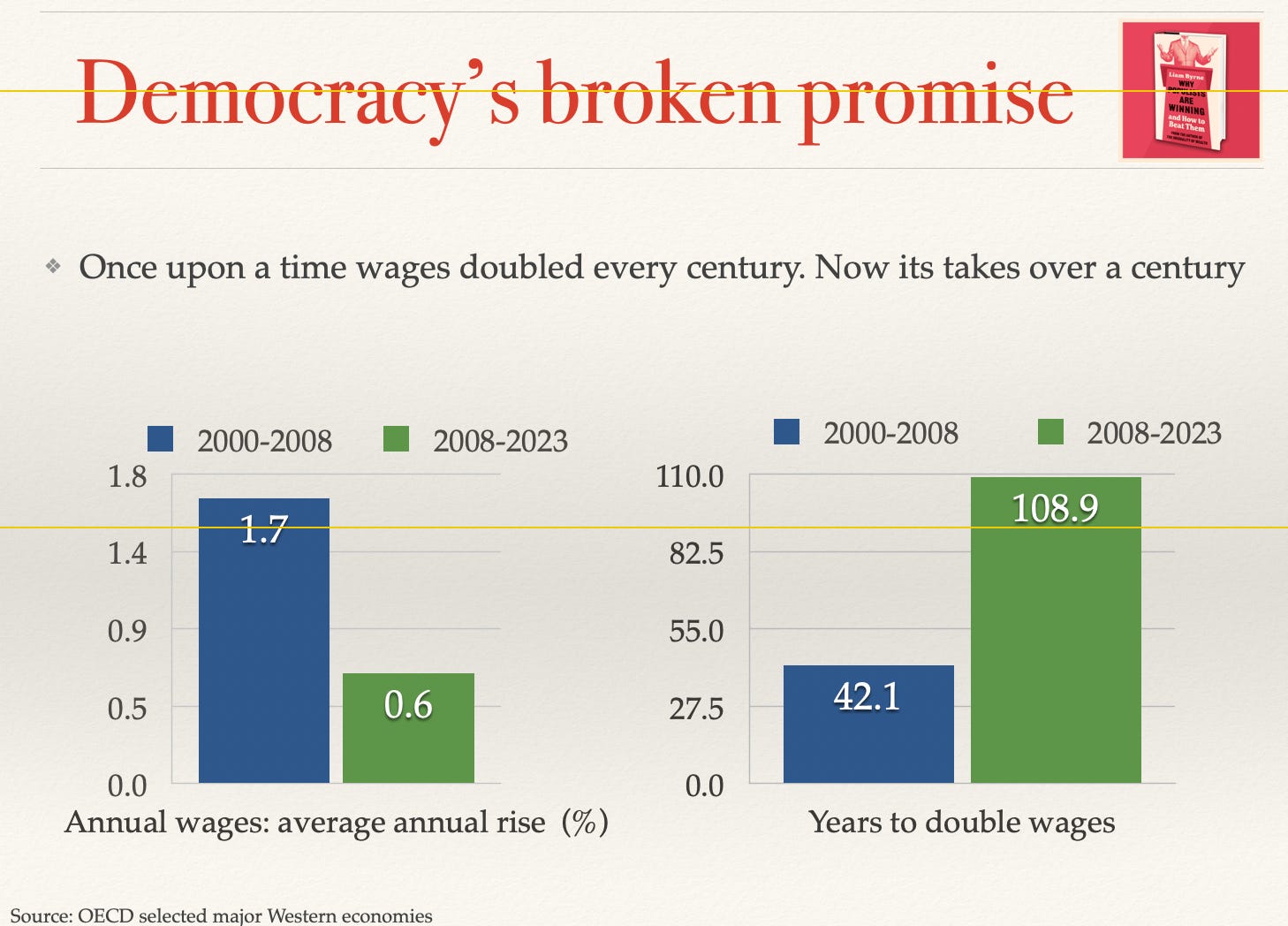
Before the financial crash, wages across advanced economies were growing by roughly 1.7% a year. At that rate, living standards could plausibly double over the course of a working life. Since 2008, wage growth has collapsed to around 0.6%. Progress that once took one generation can now take two.
Meanwhile, asset wealth exploded.
Quantitative easing inflated housing and financial markets. Those who owned assets prospered. Those dependent on wages did not. Britain became a country where wealth accelerated while work stalled.
And people know it instinctively.
Not through spreadsheets. Through lived comparison. Through what behavioural economists call relative deprivation. Through the feeling that the queue stopped moving for them while somebody else was quietly ushered to the front.
This is why the anger we see today is emotional as much as economic.
It is the pensioner who says: “I did everything right and now I’m choosing between heating and eating.”
It is the skilled worker who thought effort would buy security but now sees their children locked out of home ownership.
It is the fifty-year-old who feels respected nowhere - not by employers, not by politics, not by the culture around them.
And this anger sharpens further when economic decline is experienced geographically as well as financially. Because people do not experience political economy abstractly. They experience it through place.
That was one of the most important points to sharpen in the conversation for me. Populism is not about falling incomes. It is a sense of fair play confounded. It is about broken reciprocity. It is about the belief that democracy no longer delivers recognition, security or respect for people who believe they upheld their side of the bargain.
And unless mainstream politics can restore a visible sense of progress - tangible, local, everyday progress - then no amount of technocratic competence alone will rebuild trust.
5/. Populism is hyper-local.
One way this hits people in the face is when they look outside their front door. One of the biggest lessons from Bath was how local this crisis has become.
Politics after Covid became hyper-local.
People increasingly judge whether the country works through the space between their front door, the green space where they walk the dog, and the shop where they buy their milk.
If that triangle feels broken, politics feels broken.
At King’s, Bobby Duffy noted the rise of nostalgia across British politics. But what has struck me in my own constituency is how often nostalgia is rooted in local decline.
People are not usually nostalgic for abstract constitutional arrangements. They are nostalgic for the butcher that shut. The safe park. The functioning high street. The neighbourliness they feel has disappeared. We feel instinctively that this can be fixed by good people coming together. As Roberto Foa put it:
“There’s a real craving out there for collective action to solve our problems - and nobody’s providing that vision.”
But that craving becomes strongest where local social capital has collapsed. Too many mainstream politicians still think GDP statistics alone can restore trust. They will not when there are still boarded-up shops on the high street, the youth club still closed, parks that no longer feel safe, and fly-tipping nobody clears. While there’s a sense that nobody in authority cares what happens outside their front door, populism will flourish.
6/. Gaby Hinsliff was right: Labour now faces populism on two fronts.
The challenge in responding to this, for Labour at least, is of course, ‘asymmetric fragmentation’. The ‘right bloc’ in British politics is consolidating around Reform. The ‘left bloc’ is fracturing all over the place. Thus, one of Gaby Hinsliff’s most important observations was that populism is no longer confined to the right.
As she put it:
“Populism starts from the belief that everything’s broken, the elites have rigged the system, conventional politics has failed, and we’ve got to smash everything up and start again.”
That mood now exists across large parts of democratic politics. Reform channels it one way, capturing anger. Parts of the Greens and the radical left channel it another, capturing hope.
That leaves Labour squeezed in the middle in a sort of bloodless, managerial ‘meh’.
But Gaby also delivered the clearest warning against easy answers:
“You don’t beat populism by changing leaders. You beat it by changing people’s lives.”
That should be written on the wall of every political strategy meeting in Britain.
Because without a credible economic answer, politics descends into permanent culture war. Every debate becomes zero-sum. Every grievance becomes tribal.
That is the oxygen populism breathes.
7/. Zoe Williams was right: the centre-left cannot just describe the pain.
Zoe Williams made one of the sharpest interventions at the LSE.
Her argument was that too much progressive politics mistakes empathy for strategy.
People do not only want politicians who understand decline. They want politicians willing to confront the forces responsible for it.
What struck me most was Zoe’s insistence that modern populism benefits from asymmetry - not just the asymmetric fragmentation of the electorate but: asymmetric outrage, asymmetric amplification, asymmetric funding, asymmetric emotional intensity.
The democratic centre still too often behaves as though a better policy paper will defeat a rage machine.
It will not.
The populists name enemies. They identify villains. They turn grievance into mobilisation.
Mainstream democratic politics has often become technocratic, managerial and emotionally bloodless by comparison.
And that creates a dangerous vacuum.
8/. The populist right has built a media-political complex.
One of the most unsettling parts of researching the book was following the money.
What emerges is not simply a set of donations. It is an ecosystem: broadcasters, think tanks, influencers, donor networks, digital campaigns and pressure groups reinforcing one another.
At Bath, Dr David Klemperer asked one of the most important questions of the evening: what is the democratic response to this infrastructure?
Because populism is not just demand. It is supply. But David’s challenge to me is something I’m wrestling with: what’s the centre-left/ centre-right supply-side?
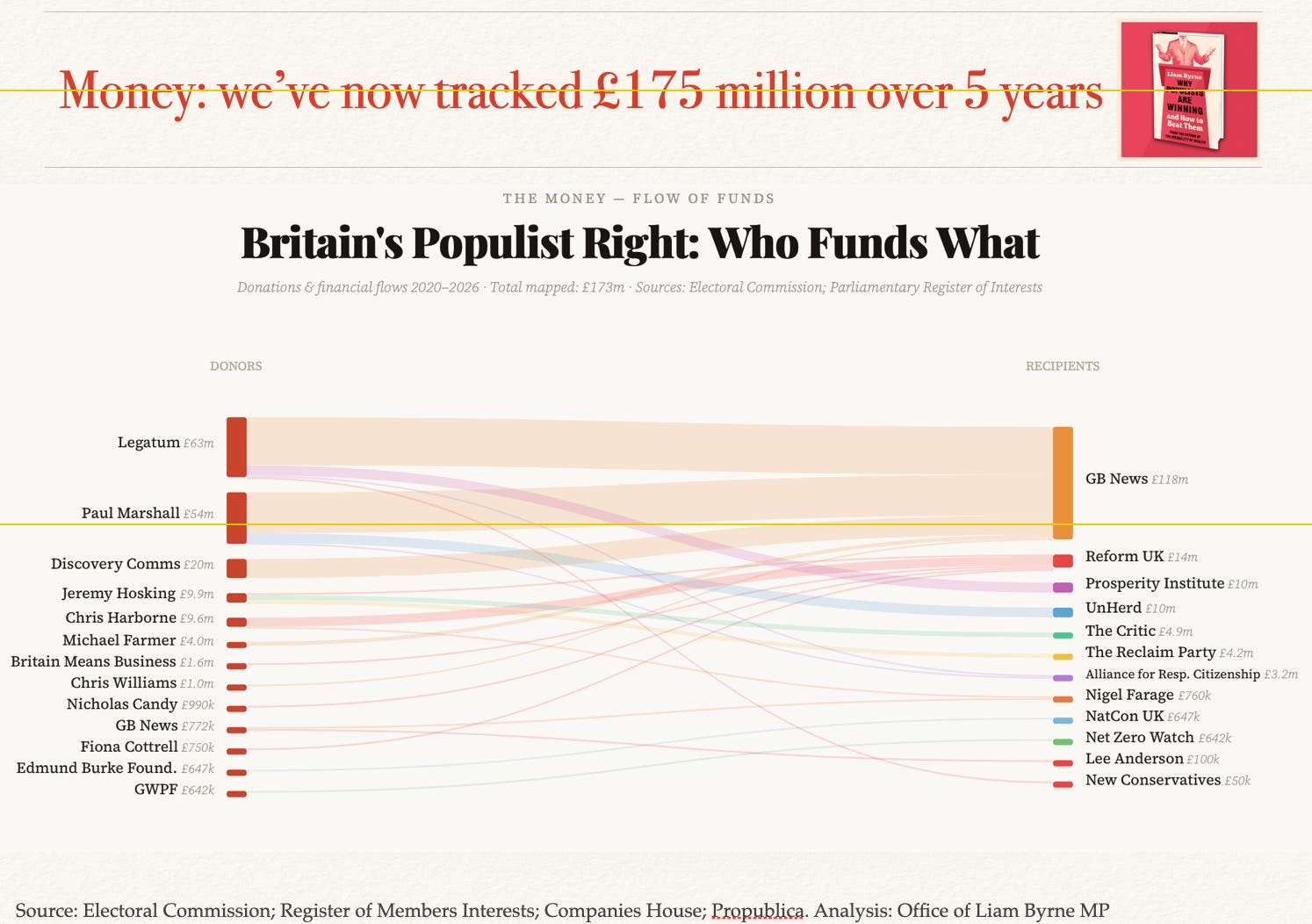
The right understood something the democratic centre underestimated for too long: politics is now inseparable from digital media systems.
As one audience member at Bath observed:
“There are a lot of people making a lot of noise - and they dominate social media.”
Exactly.
The populists understood earlier than most that outrage is no longer simply political rhetoric. It is a business model.
And unless democratic politics builds its own civic and media infrastructure, it will keep fighting twenty-first century battles with twentieth-century tools.
9/. Sam Freedman reminded us populism is not one thing - and that matters enormously.
One of the most illuminating interventions that challenged me came from Sam Freedman, because he forced the discussion away from lazy shorthand.
Too often we talk about “the populists” as though Trump, Orbán, Meloni and Farage are interchangeable. Sam argued they are not. They represent different models of radical-right politics with different strengths, different weaknesses and different strategic dilemmas.
That distinction matters because if democratic parties misunderstand the type of populism they are facing, they will fight the wrong battle.
Sam divided contemporary populism into three broad categories.
The first was what he called: “Chaotic authoritarianism.” Trump was his clearest example. Bolsonaro another.
These movements are highly ideological, highly personalised and highly disruptive. They move fast. They reject compromise. They thrive on permanent conflict. They are often openly corrupt and barely bother to conceal it.
As Sam put it, the advantage of this model is that:
“If you’re willing to break every rule and you don’t care about how you’re perceived beyond your core support, you can move very quickly.”
You can dominate the news cycle. Overwhelm institutions. Exhaust opponents. Shift the political centre of gravity before democratic systems can respond.
But Sam’s key point was that this model also exposes its weaknesses quickly.
Corruption becomes visible. Incompetence becomes visible. Economic instability becomes visible. The chaos that initially energises supporters eventually frightens voters who simply want order and security.
That is why Trump’s support can collapse suddenly. Why Bolsonaro lost. Why these movements often generate intense resistance as well as intense loyalty.
The second model Sam described was: “Focused authoritarianism.” Here Orbán was the archetype. This model is less chaotic, more strategic and more patient. Rather than trying to smash institutions immediately, it gradually captures them: the media, the courts, parts of the state, business networks and cultural institutions.
It is authoritarianism by accumulation.
And crucially, Sam argued, these leaders are often far more pragmatic than the chaotic authoritarians. Orbán, for example, has repeatedly adjusted policy to maintain power. He bribes electorates selectively. He compromises tactically. The overriding objective is not ideological purity but regime durability.
That makes this model potentially more dangerous because it can become embedded more deeply before democratic systems fully react.
Then came Sam’s third category: “Technocratic populism.” His principal example here was Giorgia Meloni. This helps explain why some populist leaders moderate once in office. Meloni still deploys the language of nationalism, identity and cultural grievance. But once in government she has compromised repeatedly - on Europe, on Ukraine, even on aspects of economic management.
As Sam pointed out, her immigration policy in practice is often less radical than the rhetoric surrounding it. Why? Because governing imposes constraints.
The more populists adapt to those constraints, the more they risk disappointing supporters who expected revolution rather than management.
And this led Sam to what I thought was his most important insight: Nigel Farage and Reform UK have not yet decided which type of populist movement they actually are.
Part of Reform gravitates toward the Trump model - permanent outrage, culture war, anti-system conflict, performative disruption. Another part wants something closer to the Meloni model: respectability, institutional credibility, a durable coalition capable of entering government. And these tensions are not superficial. They are structural.
That internal contradiction helps explain something many commentators miss: despite extraordinarily favourable conditions for populism, Reform’s rise has not been entirely linear or unstoppable. Because once populists move beyond protest politics, they encounter the same question every serious political force eventually faces:
What exactly are you for?
The brilliance of Sam’s intervention was that it shifted the debate from moral panic to strategic clarity. Populist parties are dangerous. But they are not invincible. They contain contradictions. Different factions. Different ambitions. Different theories of power. And democratic parties need to become much more sophisticated in exploiting those fractures.
“Populists thrive where the mainstream is weak.”
That may ultimately be the central lesson. The danger is real. But the outcome is not preordained.
10/. Roberto Foa asked the biggest question: where is the new democratic hegemony?
Roberto Foa’s intervention at King’s was amongst the most intellectually challenging of the fortnight.
He argued that populism may have the wrong answers - but it is asking the right questions. Questions about belonging. Security. Fairness. National identity. Collective purpose.
But Roberto pushed the discussion towards a bigger challenge:
“Hegemony in politics is about coalition formation.”
That line has stayed with me.
Because winning one election is not enough. The question is whether democratic politics can build a durable coalition capable of holding together different generations, classes and identities over time.
The centre-left often talks about policy. The populists talk about meaning. But unless democratic politics learns to combine both, it will struggle to compete. Crucially, we have to find ways in which we actually lock together a coalition of interests with an economic and social project that gives people a stake in the success of centre-ground politics - and something to lose by rejecting it.
Conclusion
Across all three events, I kept returning to one thought.
The populists offer strongman politics: one leader, one people, one enemy, one betrayal, one simple answer. We need something better. A strong society.
That is going to require a politics that spreads wealth and ownership, rebuilds local pride and rebuilds social capital, restores functioning public services, makes voters feel democracy is doing its job again.
I certainly do not have all the answers. The most useful part of these discussions was realising how many questions remain unresolved.
How do we restore growth without deepening inequality and restore confidence in the something for something deal? How do we restore a sense of just deserts?
How do we rebuild trust in a polarised age?
How do we root this in a renewed trust between neighbours, in a renewed social capital in place?
How do we create a democratic media ecosystem capable of competing with algorithmic rage?
How do we lock together a new democratic coalition equal to the scale of the crisis?
I hope that Labour’s debates over the months to come help supply some answers. Because I know this. Caution will not be enough. Managerialism will not be enough. Nostalgia will not be enough. And if democratic politics does not answer the anger of our age, darker forces will.
Thank you for this. A thought on the right wing media political ecosystem: while I think that those voices have their place in a democratic society, the fact that political journalists in this country are terminally online on X in particular, which is skews heavily rightwing and whose owner has an explicit agenda to undermine UK democracy, shapes a lot of the coverage and framing of the issues. I'm not saying that the views on there are not real, but they are given a prominence that is unwarranted given the majority of the population is not on the platform. Instead of going out into communities, like John Harris at the Guardian or Stephen Bush at the FT do, the majority of journalists, esp at the BBC, which is meant to be impartial, just sit on X and take their talking points from there. We are in a doom loop. One big corrective (not a silver bullet, but one big step) would be for our government and journalists to just log off and join us in the real world.
"unless democratic politics builds it's own civic and media infrastructure"
And stops cosying up with the tech bros...