
What does Labour do next?
Reform captures anger. The Greens capture hope. Unless Labour learns to do both — with honesty - we will be squeezed from both sides.

8am, Friday morning
So it’s all over bar the counting. Results are pouring in. A tough day and tougher weekend now unfolds for Labour, especially for candidates and Labour Party staff, who’ve been been working flat out under all kinds of pressure and still have a hell of a task ahead of them.
We’ll need the full results for a proper diagnosis, but the debate on where next for Labour is well underway. I’ll have more to say on that. But the truth is we can already read much about the changes Labour needs to make - not in the wise words of commentators - but from reading the endless leaflets that came through the door.
And this year’s crop of leaflets tells us a huge amount about how Britain’s populists are fighting - and how Labour needs to change.
Take any bit of Reform or Green’s literature from yesterday’s elections and one thing is obvious: for all the their differences, they are remarkably similar:
Both begin with a wound. Both name an enemy. Both claim to be the only vehicle for change. And both are, in their own ways, eating into the coalition that Labour needs to hold together to keep the populist right out of power.
So understanding why their literature works - and where it doesn’t - is not an academic exercise. It is a step towards understanding how to build the heroic coalition that can get Labour re-elected.
What Reform does well
Let’s start with Reform.
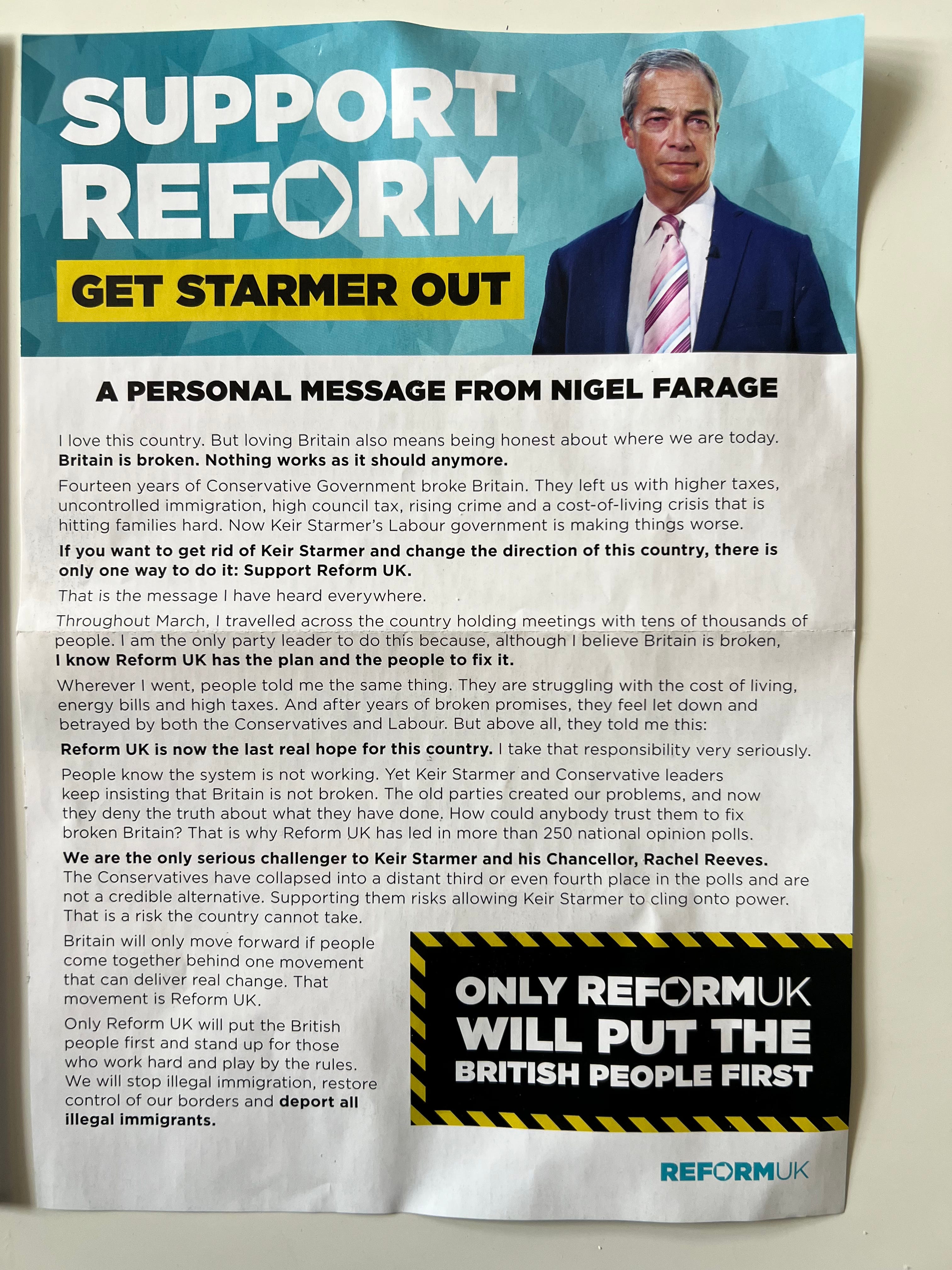
Their literature is built on a big bold move: it makes the voter feel seen. Farage’s national letter - paid-delivered I believe across the country - doesn’t open with a policy. It opens with a feeling:
“Britain is broken. Nothing works as it should anymore.”
The language is colloquial, personal, second-person singular. It accusatory - ‘They left us with higher taxes, uncontrolled immigration, high council tax, rising crime, a cost-of-living crisis hitting families hard’ - and its very similar to almost every right-wing populist speech you care to mention.
My research with Rick Foster (set out in Why Populists Are Winning) analysed populist rhetoric across the Western world and found the same fingerprint in every country: incantations of national identity and collective grievance; action-and-combat verbs - like fix, stop, deport, restore; a strong temporal swing between golden past and urgent present; and a warm conversational register that signals “I’m one of you.”
The Farage letter hits every marker. It is, as I argued in Why Populists Are Winning, three chords: patriotism and renewal; nostalgic conservatism and the promise to restore something lost; and the summons to struggle.
The local Birmingham literature adds something obvious on top. “Birmingham is broken. Vote Reform UK to fix it.” The broken-Britain thesis is translated into a broken-city thesis.
Their five pledges are ruthlessly simple: cut your bills, secure our borders, restore law and order, end council waste, put the British people first. They are not a programme of government. They are an emotional manifesto - a list of the things that make people feel the country is out of control, repackaged as promises to fix it. And pinned to the back of Farage’s letter is a poll graphic - Reform 30%, Labour 20% - with three words: “Only Reform can get Starmer out.” A simple message to the former Conservative voter that switching is safe, rational and decisive.
Where Reform breaks
The literature’s greatest strength is of course its greatest weakness: it is entirely negative. There is no vision of a future Britain that is actually better - only the removal of things. The pledges are subtractive, not constructive. Cut, stop, restore, end. And when voters - particularly the Civic Pragmatists and the Melancholy Middle (who my research with YouGov and Best for Britain) shows are the most genuinely persuadable segments of the Reform-curious electorate - begin to ask what comes next, the answer isn’t there.
The economics collapse under scrutiny. Removing VAT on domestic heating, protecting the triple lock, increasing police numbers, cutting council tax - none of the arithmetic adds up. And crucially, Farage himself is both the asset and the liability: his face dominates every piece of national literature, which works for mobilisation but raises an obvious question. Is this a movement or a personality cult? For voters who want change but distrust concentrations of power, that question will only grow more acute.
What the Greens do well
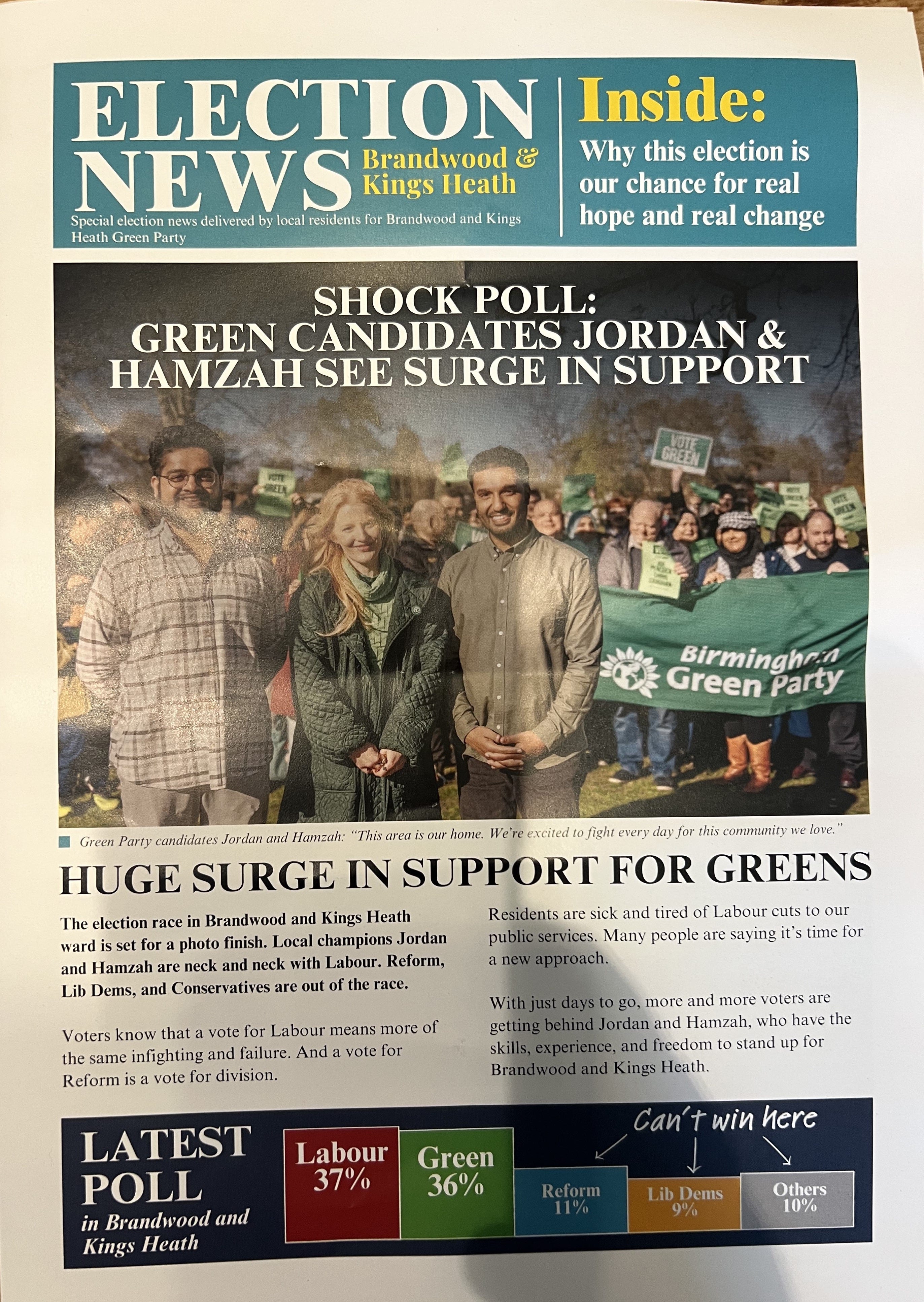
The Green Party literature - like the leaflets pushed through letterboxes in their target ward of Brandwood and Kings Heath is, a bit more sophisticated than much of their opponent’s literature. They have done something interesting: they have appropriated the Reform playbook and turned it against Labour.
The newspaper format - “Election News: Brandwood and Kings Heath” - mimics journalistic authority.
The “shock poll” headline; the photo-finish bar chart with “can’t win here” arrows pointing at Reform and the Lib Dems; the squeeze message telling voters of other parties to lend their vote - this is textbook tactical campaigning.
Elsewhere, the Greens are making ample use of the slogan “Make Hope Normal Again” - a conscious echo of the Trump slogan, repurposed for the left - and a line of genuine rhetorical ambition.
Both parties are running structurally identical campaigns: broken diagnosis, clear enemy, themselves as the only authentic alternative. The difference is that the Greens tend to add in community rootedness with some nice local candidate profiles with photos at community meetings, at the bins, or Gaza solidarity events. It is what you might call ‘politics as presence’. And the Green literature makes its central argument explicitly:
“Even good Labour councillors have to follow the party line. Green councillors can stand up for residents without fear of party bosses.”
Where the Greens break
The Green literature’s fundamental problem however is that it markets the anti-Labour frame without offering a genuinely different politics. Surprise, surprise, the national Green programme - on tax, public ownership, the pace and cost of net-zero transition - is largely absent from the local literature because it would not survive contact with the voter worried about the energy bills. (I cover this in a book review of Natalie Bennett’s Change Everything). The Greens are running a community-organising campaign dressed in party colours. It works locally. It does not add up to a governing offer.
The bloodless party in the middle
So taken together what does the literature tell us?
Reform has captured anger. The Greens have captured hope.
And the risk for Labour - the clear and present danger of this electoral moment - is to be left as the bloodless party in the middle: neither the vessel for fury nor the carrier of optimism but a managerial operation that speaks in the language of process while everyone else speaks in the language of feeling. That leaves us squeezed from both flanks simultaneously - because neither challenger has to answer the hardest question: what would you actually do in government, with real money, real constraints, and real trade-offs?
All populists refuse trade-offs.
Farage says he will cut your bills, secure the borders, restore law and order and end council waste - all at once, all by cutting cash for things you don’t like but which on closer inspection appear remarkable vauge.
The Greens will invest in public services, tackle the climate crisis, build affordable housing and stand up for human rights globally - with no account of how those commitments interact, compete or cost.
Populists of left and right have always played this game. And here is the truth that Labour keeps failing to say out loud: everyone knows it isn’t real. People are not stupid. They know that governing means choosing. The politician who treats them as adults - who is honest about the trade-offs while being clear about whose side they are on - earns something that neither Farage nor the Greens can offer: trust.
Yet what both Reform and the Greens have understood is that people do not vote on policy grids. They vote on feeling, identity and story. They vote for people who seem to understand their lives, who name the right enemies, and who offer them a role in something larger than themselves.
Reform’s story is simple → Britain is broken, the old parties did it, Farage will fix it.
The Greens’ story is → Labour has failed your community, the system serves the powerful, we’re the authentic local alternative.
Both stories are incomplete. But both are stories. And too often Labour’s message is like a list of things we’ve done, formatted like a press release.
What Strong Labour must say
The answer is not to out-Reform Reform or to out-Green the Greens. It is to build the heroic coalition - the “base plus” that Patrick English at YouGov described to me as the only route from 20% to 35%, which is the necessary minimum for governing with a majority.
That does not mean a simplistic ‘shift left’; but it does mean remobilising the progressive bloc that has splintered between Greens, Lib Dems, independents and apathy; plus keeping the right divided; plus flipping the Civic Pragmatists and the Melancholy Middle - the 40% of Reform-curious voters who are genuinely open to Labour speaks their language.
To understand the task required, here’s a few stories from my thousands of steps round Hodge Hill & Solihull North to illustrate what is needed….
First, a pensioner on the Bromford with a £3,000-a-year private pension - a reward for a lifetime of doing the right thing. But that £3,000 takes her fractionally over the threshold for pension credit and makes her liable for income tax. She is not wealthy. She is trapped, caught by a system that punishes modest savings and ignores people who fall just outside every category of support. She is angry that others who didn’t do the right thing and didn’t save, get more help (that her taxes pay for)
Then there’s the chap in Shard End dealing with cancer. He told me he had believed in Labour. He had hoped we would take on the rich and powerful - that when things got hard, we would be on his side. Instead, our maladroit approach to the necessary business of welfare reform left him feeling we were coming for his Personal Independence Payment. At the moment he most needed the state to stand with him, he felt it turning against him.
Or take the mum in Smith’s Wood who won’t let her ten-year-old children play unsupervised in the park because of the cars - speeding down residential streets, mounting pavements, parking on double yellow lines, apparently ungovernable.
Or take the residents of Albert Road in Stechford, which I’m battling to sort out for residents. The issue list is long: obstructed dropped kerbs, pavement parking out of control, a garage running overflow onto the street, potholes left unrepaired, fly-tipping traced to a specific address, homes with unsupervised supported living, and uninsured and untaxed vehicles sitting unmoved for months. It is not a catalogue of dramatic injustices. It is something worse - the steady, grinding evidence that the change people voted for in 2024, has not yet arrived. The austerity which the Tories inflicted on local councils and the police has not yet been repaired.
This sample of stories from the doorstep light up two disappointments:
The first is moral disappointment. The feeling that Labour chose the wrong targets. Winter fuel allowance. PIP reforms. The farmers. These decisions felt like Labour going after people who had done nothing wrong, at a moment when vast wealth sat largely untouched.
The second is impatience disappointment. The street still looks the same. The pothole is still there. The park still isn’t safe. This is different in character. It isn’t that Labour chose the wrong people to help. It is that the help isn’t visible yet. And the honest answer here is genuinely difficult: transformation takes time. Fourteen years of damage does not reverse in eighteen months. But that argument only lands if Labour makes a virtue, if not a drama, from the struggle, visibly, urgently, without excuses. The reason progress is slow is the scale of what was inherited, and the scale of the forces still working against change. Name them. Fight them. Show the work.
So what does a Strong Labour message actually need to do? Based on the evidence of the doorstep and the data of the research, here, fwiw, is my checklist drawn from Why Populists Are Winning.
Pride in place, rooted in who we are. All of our stories must start with pride in who we are, where we’re from - and our determination to make things better.
It is a story about us and what we built together but also its a story about the Labour Party and where we come from. People hire parties to govern because they form a judgement about their motivations, their character, their instincts. Labour was born from the conviction that working people deserved dignity, security and a fair share of the country they built and by combining together could achieve it.
That inheritance - the National Health Service, the minimum wage, the Sure Start centre, the school rebuilt, the home made affordable - is ours to claim, not Reform’s to mock or the Greens to ignore. We should say so, plainly and with pride. Not as nostalgia. As a statement of identity.
Name the villain - and light up the fight. Every story needs heroes and villains. Reform knows this. The Greens know this. Labour too often forgets it.
But naming the villain is not enough. Being seen to battle the villain is the emotional step that builds trust. People who feel the system is rigged do not primarily want to be told things will get better. They want to see someone fighting to make it better.
Franklin Roosevelt didn’t rail against poverty in the abstract. He named the economic royalists and he fought them publicly and without apology. We need the same posture. The selfish minority must have a face, and we must be seen take them on.
Secure the present. People cannot hear a vision of the future if they feel unsafe in the present. The mum who won’t let her children play outside is not asking for a manifesto. She is asking for a safe street.
Hence: Strong Labour must speak to security first. Security is not a right-wing issue. It is the precondition for everything else. Visible local action - the pothole filled, the fly-tip cleared, the unlicensed landlord held to account - is not small politics.
Look at how Mamdani has moved on exactly this in New York. It is the proof of concept for the larger argument. It shows the state working.
Tackle the inequality of progress. The deepest wound in our politics is not poverty - it is the sense that progress has stopped. That you work harder, save carefully, do everything right and still fall behind.
The pensioner with her £3,000 private pension is not just caught in a bureaucratic trap. She is the human face of a system rigged against the people who played by the rules.
Strong Labour must name this directly: not simply redistribution, but restitution. Crucially, that means restoring the something-for-something bargain.
At the heart of Labour’s fairness code has always been a simple compact: contribute to the community, and the community will be there for you when you need it. That bargain has broken down.
Strong Labour must restore that covenant explicitly - making clear that rights come with responsibilities, that contribution is honoured, and that the most vulnerable will never be the ones who pay the price for the failures of the powerful.
Be honest about trade-offs and honest about time. This is perhaps our greatest and most neglected political virtue - and it has two dimensions.
The first is honesty about choices: governing means deciding, and decisions have costs. We will be straight about who pays and why, and we will always ensure the burden falls on those with the broadest shoulders.
The second is honesty about pace: some of what people are waiting for will take longer than anyone wants. Fourteen years of damage, decades of underinvestment, a system designed to resist change - these are real obstacles, not excuses.
But here is the difference between us and the populists: we will name those obstacles, show the work, and fight visibly against the forces slowing progress down. Populists refuse trade-offs because they are not serious about governing. We refuse to pretend trade-offs don’t exist. In an age of magical thinking, honesty is a radical act.
The choice that matters
Reform has a simple offer: anger, with Farage as its vessel. The Greens have a simple offer: hope, with protest as its vehicle. Strong Labour’s offer is more complex, more honest, and ultimately more powerful than either - because it is grounded in something neither of them can claim: a record of actually governing, and a set of values that have stood the test of more than a century. Those values rest on two ideas: security and progress. Not one or the other. Both, together, won through visible struggle, delivered with honesty, rooted in a century of Labour values that were built from the bottom up.
Why Populists Are Winning & How to Beat Them is here: https://m.cmpgn.page/wpbppt
The hatred and vitriol shown towards Kier Starmer is irrational and dangerous. This needs to be countered. If Labour MPs think it will be a honeymoon for the likes of Raynor, Streeting or Burnham they need to think again … the divisive media etc is powerful and needs to be countered. Labour MPs or councillors aren’t entitled to have a job for life so they should focus on achieving the things they were elected for and join the single market and customs union and campaign along the lines you have correctly identified. A leadership election will further the demise of the party if you haven’t delivered in five years you aren’t entitled to reelection.
You were going so well until you focused on analog literature. These elections were lost 2 years ago with the catastrophic WFA position / later U-turned. It helped turbo-charge an inherited resentment about ‘uniparty’ politics against which ReformUK marketed - not campaigned - against via social media. They built directly on the 2016 Trump playbook, augmented by 2024 tactics. All that came with a technology backbone that is FAR superior to ours.